KNX reconstruction — when no one can access the system any more.
Integrator no longer reachable, ETS project vanished, and nobody dares touch it? We read out your system, reconstruct the project and give you back control — from the detached house through the villa on Mallorca to the logistics hall. For distant properties we start with a remote diagnosis — we send a gateway, read out and estimate the effort before anyone travels.
Three sentences we hear all the time.
Orphaned KNX systems are no isolated case — and almost never a technical problem. It is a documentation problem, and that can be solved.
The integrator is gone
The firm that built your system no longer exists, has retired or does not answer. Nobody feels responsible, and every electrician you ask waves you off.
The ETS project is missing
Without the project file, no one can change anything. The system keeps running as it did on handover day — but every adjustment, every extension and every fault search is blocked.
It works, but nobody knows why
Push-buttons switch things no one can explain. Scenes lead nowhere. A room has changed use and the controls know nothing about it. The system is frozen in the state it was handed over in.
This exact topic, in one episode.
Episode 40 of our podcast: what owners should know when the KNX project file is lost.
Specialist software and years on the bus.
Reading out an orphaned system is no standard task. It takes tools beyond the basic kit — and experience that cannot be acquired on a course.
Specialist software instead of standard tools.
We work with professional diagnostic and analysis tools that go far beyond what an electrical contractor's standard kit contains.
- Reading out complete systems
- Telegram and load analysis on the bus
- Reconstruction without a project file
- Gateway and protocol analysis
We teach KNX.
As certified KNX trainers we have taught the technology needed here for years — at a depth that goes well beyond the knowledge of typical integrators and electricians.
- Certified KNX trainers
- Over 100 projects in three countries
- Engineers, technicians and master electricians
- Special cases are routine for us
A KNX system is almost never dead.
Rip everything out, start again.
The reflex is understandable: when nobody can get into the controls any more, a new installation sounds like the clean break.
- Construction time and dirt in an occupied house
- Working technology ends up in the skip
- Weeks without a usable system
- The cost of a complete new installation
Read out, reconstruct, build on.
KNX is an open standard: the devices on the bus can be read out — regardless of who programmed them.
- Cabling and devices stay
- A fraction of the effort
- No dust, no dismantling
- Extendable again afterwards
This is what a reconstruction really looks like.
On the left, the same system straight after readout; on the right, after our work. The addresses are real, and so are the names — from the halls of Fiege Logistik.
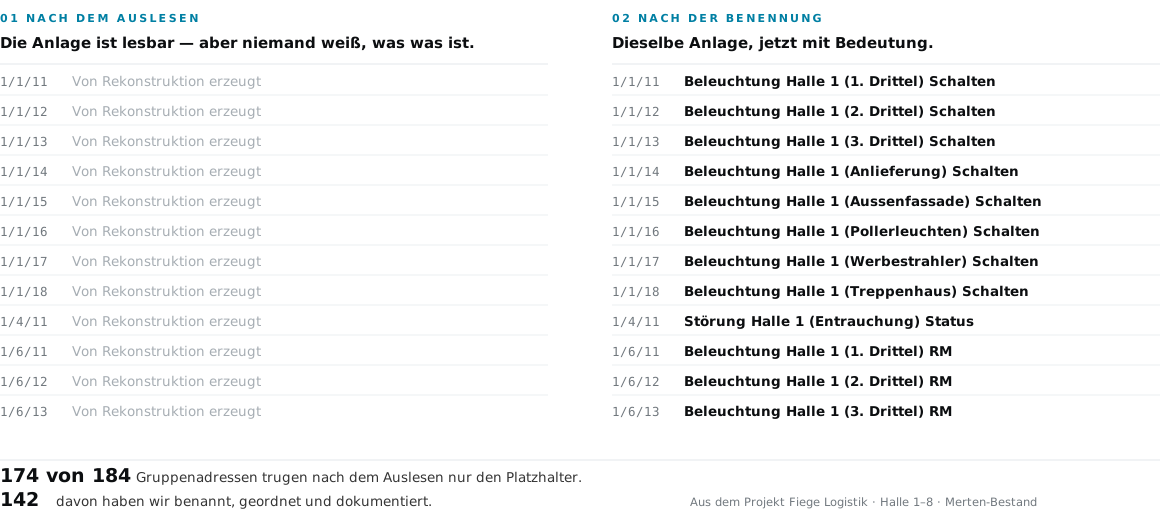
142group addresses once again carry a name that any contractor can work with. The figures are in the graphic.
This is the honest part: the old names cannot be recovered — they were never stored in the device. We assign them afresh. What stands at the end is a complete project, not the old one.
What actually happens in a reconstruction.
Reconstruction is detective work on the bus — here is what it involves in detail, from the private house to the logistics hall with third-party trades.
Determining individual addresses
We identify every device on the bus, assign it to lines and areas and also find the bus devices that appear in no documentation. In larger systems with several lines and couplers, precisely that is the real legwork.
Reconstruct group addresses
From the links between the devices a readable structure emerges again: what switches what, which feedback belongs where, which address is dead. We build a clean, three-level scheme instead of organically grown sprawl.
Identify application programs
Every device has an application program in a specific version. We determine it, source missing product databases and clarify where an update makes sense and where it would destroy the existing parameterisation.
Bus diagnostics & telegram load
With the group and bus monitor we see what is really happening: continuous transmitters, overloaded lines, sporadic failures, voltage dips. Many “inexplicable” faults in existing systems are diagnostic issues, not device issues.
BACnet, Modbus & third-party gateways
In commercial properties, ventilation, refrigeration, heating and the building management system hang off the system via gateways. We program and reconstruct these interfaces — data point lists, object types, addressing — so that the trades talk to each other again.
Logistics halls & commercial buildings
Large halls bring their own topics: hall lighting in groups and zones, daylight control, gates and loading equipment, ventilation and smoke extraction, operating and weekly schedules. We reconstruct these logics instead of reinventing them.
Restoring the visualisation
If the server is dead or the password lost, we rebuild the visualisation — with a clear room and function structure, user rights and secure remote access. Often this is the moment an old system feels modern for the first time.
Modernising instead of replacing
Reconstruction does not mean dismantling: existing actuators and sensors stay where they are up to the job. Additions are made selectively — new control points, a logic module, energy metering, connection of a heat pump or wallbox. The bus in the wall remains untouched.
Extending after the rescue
Once the project is cleanly in place again, extensions are normal again: additional rooms, new scenes, trades that were missing until now. Precisely this ability to act is the real result of the reconstruction.
Remote diagnosis & gateway dispatch
Not nearby? Then the system comes to us rather than us to it: we send you a preconfigured gateway that an electrician on site merely has to connect. We then read out the system remotely, analyse bus and structure — and deliver a sound estimate of the effort before anyone travels.
International & language-independent
An ETS file knows no national language. We have reconstructed villas on Mallorca where neither project nor documentation existed — device data, group addresses and application programs read the same in every country. On site we work with local electricians; the programming stays with us.
Holiday properties & second homes
With properties abroad in particular this case is standard: the installer is no longer within reach, the owner only there a few weeks a year. We bundle system readout and commissioning into a few on-site visits and handle the rest via remote access.
Handover with everything that goes with it
ETS project, group address list, device list, functional documentation and access credentials — complete and in your name. We also keep a copy on file so that the same situation does not arise again in ten years.
At the end there is not just a running system but a complete ETS project in your name — the insurance against the same situation ever arising again.
Four steps back to being in control.
System readout — on site or remotely
In the Rhineland we come round and look at distribution boards, devices, labelling and bus cabling. For distant properties we send a preconfigured gateway: have it connected, done — we read out remotely. In both cases the result is an honest assessment of what can be reconstructed and at what effort.
Read out the system
We go onto the bus with the ETS and read out what is there: individual addresses, installed devices, application programs, group addresses and their links. The bus monitor additionally shows which telegrams actually run during operation.
Reconstructing the project
From the read-out data a new, clean ETS project emerges: topology, device assignment, structured group addresses, comprehensible naming. Where application programs are missing or outdated, we clarify replacement or updating.
Checking, testing, documenting
Every function is checked room by room and logged. You receive the complete ETS project, the group address list and clear functional documentation — from that moment on, your system belongs to you again.
Reconstruct — or reprogram?
Not every system should be reconstructed. These points decide it, and we tell you before the quotation.
Reconstruction is worthwhile if …
the system does what it should day to day, and it is just that no one can intervene any more. If many devices are installed, the parameterisation was done cleanly and you want to keep the existing installation. Then the effort is a fraction of a new installation — no dust, no construction time.
Reprogramming is more honest if …
the system is small, the existing parameterisation is no good anyway, or a large share of the devices needs a manufacturer's add-on program. Then reading out is more effort than a clean fresh start — and we tell you so, even if it makes the job smaller.
Where even we get stuck.
There are cases where readout is not possible. Anyone who conceals that has not experienced it yet.
KNX Secure without the key file
If a system is set up with KNX Secure and the keyring is missing, it cannot be read out. The certificates printed on the devices do not help — they are replaced at commissioning.
Lost project password
If an existing project file is protected by a password nobody knows any more, there is no master key. Then the only route is via the system itself.
Devices with add-on programs
Some devices can only be parameterised with a manufacturer's add-on program. These settings do not come across during readout and have to be rebuilt.
Battery-powered wireless devices
Battery-powered wireless components do not announce themselves on the bus. They have to be addressed individually by hand — which only works on site.
An order of magnitude, not a platitude.
“A custom quotation” helps no one think it through. So here is an anchor you can orient yourself by.
A detached house of about 150 m², switching and dimming actuators. For that we need roughly a week.
More devices means more to read out and, above all, more to name. Naming is the biggest share of the work.
If logic modules are involved, it takes longer. Commercial systems likewise — third-party trades often sit on the bus there.
A phone call and an initial indication cost nothing. Only after that do we talk about effort.
From the private house to the logistics hall.
Private house, Oberhausen
A system that grew over the years and that nobody had been able to get into for a long time. Taken over and set up afresh: reprogrammed, new lighting control, new visualisation — without a single new cable.
Fiege Logistik
The system from the proof further up: hall lighting in zones, weather station, gates and fault alarms. 184 group addresses read out, 142 of them named and documented.
Gesamtschule Düsseldorf, Bismarckstraße sports hall
A public building in ongoing operation: system taken over, controls made intelligible and handed over to the property management — without shutting the hall down.
Villas on Mallorca
Entire villas without any project file — a common case with holiday properties. We read out, reconstruct and hand over: language-independent, because the ETS is the same in every country.
Where do you stand right now?
Five typical cases — each with its own route. Choose the one that fits your system. Reconstruction is a case of KNX service: it brings back the foundation so that anything at all is possible afterwards.
The ETS file is lost
Project file gone, password-protected or hopelessly outdated — the system can still be recovered.
View case → 02I do not know what is installed
Read out an existing system and document it clearly when project file and overview are missing.
View case → 03My integrator is no longer around
Firm insolvent, retired or unreachable. We take over the system and remain reachable.
View case → 04The property is abroad
Villa on Mallorca, holiday property, project anywhere in Germany: remote diagnosis and gateway dispatch before any travel.
View case → 05The documents exist, something is to be added
Extension, loft conversion, heat pump or wallbox on a running system: first check what the bus can carry, then plan.
View case →You do not need to know what is installed.
Most people who get in touch here have taken over a house and know of the controls only that they exist. That is enough to start with. Four questions, then we talk.
- 01We read your answers and get back to you — usually on the same working day.
- 02Ten minutes on the phone, in which we sort out what exists and what is missing. A photo of the distribution board helps, but is not a requirement.
- 03Then a written assessment with an effort range. Only then do you decide.
Even "in your case this is not worth doing" is a result we will tell you. Both cost you nothing.
Rather talk straight away+49 211 838 66 870Ask your electrical contractor first.
The fastest and cheapest route to the project file is almost always to request it from the firm that carried out the work. We reconstruct when that fails — not before. Here is a text you can copy.
Subject: Request for the KNX project documentation for the property [street, postcode town]
Dear Sir or Madam,
We are the owners of the property at [street, postcode town]. To our knowledge, the KNX system installed there was set up and commissioned by you.
For continued operation, maintenance and the replacement of faulty devices we need the associated project documentation. Specifically, we ask you to hand over, where available:
the ETS project file in .knxproj format, including the project password and a note of which ETS version was last used · for a system with KNX Secure, the keyring (.knxkeys); the certificates printed on the devices do not replace it · the configuration file of any existing visualisation together with its access credentials · a device and group address list, plus any existing circuit diagrams or distribution board documentation
We are aware that the question of an obligation to hand over these materials is not judged uniformly in law. We expressly do not wish to contest this point, but to ensure that the system can continue to be maintained in future. Should compiling them involve effort, we ask for a brief quotation; we will bear a reasonable fee.
A drafting aid, not legal advice. The legal position on handing over the programming is not settled; there is no ruling specifically on the ETS project file.
System in place? Call us.
For urgent cases in commercial and logistics properties we come out at short notice — outside operating hours on request.
KNX reconstruction in Cologne, Düsseldorf & NRW.
smartfabrik is a smart home planning practice based in Düsseldorf (Reisholzer Werftstr. 31A). We plan for private clients and companies in Cologne, Düsseldorf and across North Rhine-Westphalia — and, where wanted, nationwide and internationally. A selection of the places we have already planned and delivered in:
Frequent questions about existing KNX systems.
Twenty-eight questions we are actually asked — answered without promising anything we cannot keep.
What those affected ask first
We have bought a detached house with an existing KNX installation, and there is no project file. How do we start?
We see this case often, and it can usually be solved — we can only say for certain once we know what is installed in your house. The first step is therefore taking stock: a list of the devices with manufacturer and type, plus whether there is a bus interface, meaning an IP or USB interface. A photo of the distribution board is usually enough for that — please have the cover opened only by a qualified electrician, there are 230 volts behind it. From the system itself, in many cases the individual addresses, the group addresses and their links can be read out and transferred into a new ETS project. Whether that succeeds completely in your case depends on the installed devices: each device needs the exactly matching application version, and KNX Secure without a keyring, devices with their own plug-in and battery-powered wireless devices set limits. We check that before you decide. What never comes back are names and descriptions. That a particular group address switches the light in the dining room is stored nowhere on the bus. We do this naming afresh, together with you in the house — with the result that a clean, named project then exists. An initial assessment and the phone call cost you nothing.
Which component actually holds the programming, and can it be read out?
There is no central store where the project lives. Every device on the bus carries its own part: its individual address, its parameter settings and the group addresses assigned to its communication objects. Exactly that can be read out device by device and assembled into an overall picture — as far as the devices are readable. Two preconditions need saying. First, each device needs its application program in exactly the matching version; if it is missing, the device cannot be taken cleanly into the project. Second: with KNX Secure, nobody gets at the data without the matching keyring, us included. The FDSK printed on the device does not help here — it is replaced at first commissioning by an internally generated key. That is a widespread misconception, and it regularly costs customers time. What is not stored in the device is the plain-text naming of your project: area, line, device and group address names are stored in ETS. They cannot be recovered and are assigned afresh.
What do I get at the end, and what will still be missing?
You get an ETS project of your system: the devices read out with their application programs, the individual addresses, the parameters and the group address structure including links. With that, the system can as a rule be changed, extended and worked on by any electrical contractor again. Where individual devices cannot be read out, or their application program can no longer be obtained in the matching version, we record that explicitly in the project. You should know where you stand rather than stumble over a gap later. What cannot be restored are the original names and the structure of the old project — those existed only in the lost file. We therefore assign the naming afresh and organise it by rooms and functions. To do that, we walk through the house with you and match up what switches what, where. At the end you have complete, named documentation of your system that you can read yourself.
An electrician says it is a write-off and has to be redone completely. Can't all the devices simply be taught in again?
First, on “teaching in”: KNX devices do not teach each other in; there is no pairing as with wireless plug-in sockets. Every assignment is written into the devices with the ETS. Without a project there is no way around that — that is the core of the problem. That the whole system must therefore be replaced is often not true. In many detached houses the existing devices can be read out and carried over into a new project without opening ceilings or swapping actuators. The distinction matters: reprogramming means resetting all devices and building the complete function up from zero. That is the far bigger intervention and makes sense above all if you want larger changes anyway. Reconstruction, by contrast, carries over what already works. There are cases in which your electrician is proved right and only recommissioning truly remains: KNX Secure without the keyring, devices whose application program can no longer be obtained in the matching version, devices with their own plug-in, and battery-powered wireless devices. Which of these applies to you, we check beforehand and tell you openly before you spend money. On the division of roles: we are planners and work on the project. Everything on the electrical installation — swapping, terminals, 230 volts — is done by an electrical contractor, either our sister company elektrofabrik or your own contractor locally.
What does it cost to have a project file reconstructed, and is there an inexpensive way?
As a guide: for a detached house of around 150 square metres with essentially switching and dimming actuators, we allow about a week of work and around 5,000 euros net. That is expressly an anchor for orientation, not a fixed price. The effort depends above all on the number of devices. If logic modules are involved, it takes longer. Commercial systems can sit above that. A reliable price only emerges once we know what is installed. On the cheap route, answered honestly: the biggest lever lies with you. Gather everything that still exists — old group address lists, circuit diagrams, photos of the distribution board, handover folders, emails from the electrical contractor. Every piece of information that survived saves reading out and matching. And join the walkthrough of the house yourself: matching functions to names is the most time-consuming part, and nobody knows your house better than you. The initial indication and the phone consultation cost nothing. So you know the range you are in before you decide.
How long does it take, and does the system keep running in the meantime?
For a detached house of the size described above we allow about a week, correspondingly longer for larger or logic-heavy systems. Reading out is at its core a read operation. Your system usually keeps running normally, lights, blinds and heating work as usual. Brief interruptions affect individual devices when we put them into programming mode or reload something — that takes minutes each time, not days, and we tell you beforehand when. We need an appointment for the walkthrough in which functions are matched to names. Somebody should come along who knows what switches what in the house; how long it takes depends on the size of the system, and we agree it with you in advance. If a KNX Secure system has to be recommissioned, there is planned downtime. We discuss that beforehand, before anything is touched.
My electrician will not hand over the program file. Is he allowed to do that?
Honestly: the legal position on this is not settled, and we are planners, not lawyers. There are arguments that the programming is part of the work owed, and the documentation with it — and there are firms that invoke rights of their own in the programming. Both positions are held. You should treat neither as settled, and we present neither here. The best practical first step is almost always the calm one: a factual written request referencing property and order, ideally combined with an offer to pay for the effort of compiling everything. That resolves many cases without anyone having to fight. You will find a template below. If that leads nowhere, reconstruction is a route that makes you independent of that firm. If you want to take the legal route, please seek advice from a lawyer. We will gladly supply the technical description of what is missing and what you need it for.
The electrician is gone, the firm is bankrupt and nobody can be reached. What now?
Technically this changes little. The route via the system works regardless of whether the installing firm still exists: we read out the installed devices and build a new ETS project from them, which you and any future firm can access. A brief attempt is still worthwhile. Ask the insolvency administrator, and if you can reach anyone, former employees too. An old project file, a backup or even just a group address list saves time and therefore money. If nothing comes back, that is no disaster — we then work solely with what the system itself yields. One thing we need to know beforehand: whether the system runs KNX Secure. Then we need the keyring, and no one can replace it. The code printed on the devices (FDSK) is no longer any help after first commissioning either.
We have the knxproj file, but no one knows the password. Can you open it?
No — and do not let anyone promise you otherwise. A forgotten project password is lost for good. There is no manufacturer master key and no official back door, and the KNX Association cannot reset a password either. The official KNX Project Recovery Service does exist, but it does not help here: it repairs damaged .knxproj files and neither reconstructs from the system nor replaces a password. That does not mean the system itself is lost. We read out the devices and rebuild the project, exactly as with a completely missing file. One difference has to be stated honestly: with the password you would also have had the old names and the old structure. Those do not come back via the system; we redo the naming. Before we go down this route, please check whether the password is documented anywhere: handover documents, old emails from the electrical contractor, password managers, the previous owner's paperwork. That is the quickest and cheapest find to be made here.
I thought I would just disconnect the old actuator and connect the new one. Can I swap a faulty device without programming?
As a rule, no. A new device comes out of the box in its factory state, that is with the default address 15.15.255 and without your parameterisation. It does not know which group address belongs on which output. ETS writes that assignment into the device, and that takes a project. As a stopgap: many actuators have a manual override that lets a channel be switched directly at the device. That helps short term, but does not replace the programming. Important to know: a faulty device usually can no longer be read out. The information from precisely that device is then missing from a later reconstruction. That is the sober reason not to tackle the project file only once something has already failed. It is not an emergency as long as the system runs — it just tends to become more laborious later rather than easier. With a complete project, the swap is routine: the electrical contractor swaps the device, then the parameterisation is loaded from the project.
How can I find out for myself why a light or the heating is not working, without the electrician coming out every time?
With a complete ETS project, exactly that becomes possible. You see which group address belongs to which load, can monitor the bus through an interface and can tell whether a push-button is not sending, an actuator is not switching or a logic function is interfering. Without a project, every fault search begins with searching — and that time ends up on the invoice. Said honestly: you need an ETS licence, a bus interface and some familiarisation for this. And everything on the 230-volt side remains a matter for the electrical contractor. A middle course is therefore realistic. You get a cleanly named project from us and a clear function overview. With that, no one has to explain the system afresh when a fault occurs, and the visit on site stays short. Smaller adjustments to the project we can also make remotely on request.
We would like to change the labelling and the order of the buttons on a few displays, but we have no project file.
Such changes live in the parameters of the device in question. That requires an ETS project with the matching application program. After the reconstruction, texts, button assignments and their order can as a rule be changed again, and again later on. Two restrictions we name up front, because they are documented. Gira documents for older push-button sensors — the push-button sensor 2/3 plus and the push-button sensor with controller — that after readout these devices do not permanently accept changes. And devices configured via their own plug-in or the manufacturer's own software are generally tricky in a reconstruction. If that applies to your devices, we say so before you place the order. For those individual devices a reprogramming is then needed, while the rest of the system remains untouched. Which devices you have, we can tell from the type plate or from a photo.
What is technically possible and what is not
Does this work with every KNX system, or are there cases where you get stuck?
Often yes — the programming sits in the devices themselves and can be retrieved from there. But there are limits, and we name them openly: a system with KNX Secure for which nobody has the key file (keyring) any more; devices that strictly require an add-on program from the manufacturer; battery-powered wireless devices that have to be addressed individually by hand; systems set up in Hager easy mode; and individual devices whose exact application version can no longer be sourced anywhere. Add individual older devices that no longer accept permanent changes after being read out. Which of these applies to your system we clarify in advance as far as it can be done remotely — the initial assessment and the phone call cost nothing. Some things only show at the bus; if we hit a limit there, we tell you immediately, together with the consequence for effort and outcome.
Is the result in the end really what is in the system — or do you guess in places?
What comes out of the devices is not guessed. What is read out is the image actually programmed in the device, and this image is matched against the appropriate application database. Only when both fit together does a device count as fully resolved for us. If a device remains incomplete after that, the result says so, and we tell you which device is affected and what that means in practice. Three things you should know. First: group addresses, parameters and links come back, the naming does not — we redo it, with the result that a clean, complete project then exists. Second: with devices that work only via a manufacturer's add-on program, parameters may not be readable; there we recreate the function from its actual behaviour in the house and mark exactly these devices in the result, so you know where things were reconstructed and where read out. Third: some older devices no longer permanently accept changes after readout; Gira documents this itself for the push-button sensor 2 and 3 plus and the push-button sensor with controller.
Why do you not find all devices when scanning the bus?
That is normal and can usually be explained. Typical causes are a filter setting in the line or area coupler, two devices with the same individual address, a topology that does not follow the standard, locked or protected devices, and battery-powered wireless devices that simply do not answer in sleep mode. We follow these points up, because every device not found would later be a gap in the project. The honest limit: some of these causes can only be resolved directly at the device or in the distribution board. That takes somebody on site — your electrical contractor or our sister company elektrofabrik. We are planners and do not work on the electrical installation ourselves. What on-site visits are needed, we tell you before you place an order.
Our system is KNX Secure, and there is neither a project nor the key file. Can you get in?
Without the matching key, a Secure device cannot be read out. There is no back door and no master key. The route that remains is a factory reset on every affected device and a fresh commissioning with the device-specific key (FDSK), which you will find on the sticker on the device or on the device certificate. Important, so that you can decide properly: with the factory reset, that device's existing programming is gone. The function is not recovered but replanned and reloaded. That is considerably more effort than a reconstruction, especially as every device must be physically accessible — including devices in ceilings, cavity walls or window frames. The work on the installation is carried out by your electrical contractor or our sister company elektrofabrik; we plan and engineer the project. Until then your system keeps running unchanged, and at the end there is a complete, cleanly documented project. How many devices are really affected is something we look at beforehand — it happens that only part of a system is programmed secure.
What is this keyring you ask about before you even begin — and does the system simply keep running afterwards?
The keyring is the key file that belongs to a Secure project; it holds the keys of the devices. If it is available, reading out is usually uncritical and your system keeps running. If it is missing, the affected devices must be reset and commissioned with new keys. The keys in the project then change, and everything that needs to communicate — IP devices, visualisation, server components — must be reloaded as well. That is plannable but real downtime. How long it lasts depends on the number of devices affected; it is set out in the quotation and the scheduling before you place an order. That is why we ask about it right at the start: the keyring decides effort, procedure and schedule.
The stickers on the devices are gone or covered over. Can the manufacturer resupply the key?
As a rule, assume there will be no resupply — that is precisely the point of this key. Important to know: the printed key alone does not open a device that has already been commissioned anyway, because ETS replaces it at first commissioning with a project-specific key (Tool Key). It only helps again after a factory reset, when the device is taken in afresh. If sticker and device certificate are missing, and neither a keyring nor an accessible project exists, practically all that remains for this device is unsecured operation, if the product supports it, or replacement — carried out by your electrical contractor or our sister company elektrofabrik. Before you dismantle anything: send us photos you can take safely. In our experience, device certificates are found in the cabinet lid, in the building file or with the electrical contractor who built the system. Please have the distribution board itself opened only by a qualified electrician.
There is supposedly a tool that cracks ETS project passwords. Why don't you simply use it?
Vulnerabilities have been published for older ETS versions. We do not work with them: that is a security hole, not a way of providing a service. Factually it would gain you nothing either, because a lost project password is lost for good — there are no master keys and no body that restores it. The reliable route runs not through the old file but through the system itself: we read out the devices and build from them a new, complete project whose password you know. In every case, the precondition is that you are the owner or authorised operator of the system. We clarify that before the engagement, and in both directions: for your protection and for ours.
ETS asks for a BCU key, and nobody knows it. What does that mean for us?
This is the safeguard from the era before KNX Secure; we meet it mainly in older systems, and often the same key was assigned project-wide to all devices. It primarily protects programming, not necessarily reading. Depending on the product we can therefore often still read out the devices and build a complete project, while writing new parameters back remains blocked. How far that goes depends on the specific product and can only be said seriously at the device. If devices remain locked, the options are a reset via the manufacturer, where offered, or replacement. How many devices are affected only shows at the system: if the same key was assigned project-wide, more than one device can be hit. We tell you the result of this check before it becomes a quotation.
For owners, managers and operators
Who maintains, who checks, who documents? And who is liable if none of that works out?
For the KNX part, the missing foundation can usually be restored: we read out the system and produce from it a complete, handover-ready ETS project, which you receive and can make available to any maintenance provider. That settles the question everything else hangs on — without a project, every inspection, every change and every piece of documentation on the bus is laborious and in parts cannot be reliably evidenced. Two limits up front: if the system is built with KNX Secure and the keyring is missing, it cannot be read out. And the original names of rooms, devices and group addresses are not stored in the system; they do not come back, but are assigned afresh in coordination with your operating staff — with the result that a clean, complete project then exists. On liability: that is a contractual and legal question and belongs with your lawyer, not in an FAQ. As a rule of thumb, carrying out tasks can be delegated, but operator responsibility does not thereby disappear entirely. And on roles: smartfabrik is a manufacturer-independent planner, we survey, plan and document; work on the electrical installation is carried out by our sister company elektrofabrik or your own contractor.
Can anyone shut our system down because the documentation is missing?
Whether an authority or an expert assessor can go that far is a question of the individual case and one for legal assessment — in our experience, the missing ETS file alone is rarely the trigger. It becomes critical where a function is subject to mandatory verification and no one can prove any longer how it was parameterised. The good news: in most cases precisely this proof can be restored, without dismantling and without replacing the system. We survey the installation, read out the readable devices and deliver a project that reflects the actual state and makes it verifiable. One limit we clarify up front: if the system is built with KNX Secure and the keyring can no longer be found, it cannot be read out — the FDSK printed on the device does not help then, because it is replaced by the Tool Key at first commissioning. In that case the route is a master reset and recommissioning of the affected devices, with corresponding downtime; what that requires per device, we check beforehand. That then belongs in the quotation, not in the small print.
We are inspecting a property before purchase. What is in a system without a project file?
The practical risk is easy to describe and therefore easy to put a figure on: without a project file, every small matter becomes a project — tenant fit-out, change of use, even swapping a faulty actuator, because what the device is supposed to do must first be reconstructed. Add the dependence on precisely the one provider who still knows the system. For due diligence the item can be budgeted cleanly: the effort depends above all on the device count. As an anchor, a detached house of around 150 m² with switching and dimming actuators sits at about a week and around 5,000 euros net. That is expressly an anchor for orientation, not a fixed price — and it cannot be scaled up to a commercial property: with logic modules it takes longer, commercial systems can take considerably longer. An initial indication and the phone call cost nothing; the figure becomes reliable once we have seen photos of the distribution boards or a device list. The assessment should also include one check: if the system is built with KNX Secure and the keyring cannot be found, readout is not possible — then you budget for recommissioning instead of reconstruction, and that is a different order of magnitude.
How much of the existing technology can we keep, and what has to go?
In most cases the existing installation remains usable, even with very old systems: at bus level, KNX devices of different generations work together, and actuators, cabling and distribution board layout are rarely the problem. The limit is not the bus but the tools — reconstruction needs exactly the same application version for each device. That is precisely what the system readout answers concretely instead of in blanket terms: which devices are on the bus, in which application version, and is that version still obtainable. Honestly named exceptions: devices that need a manufacturer plug-in, battery-powered KNX RF components, devices with a BCU key set — it mainly protects programming and behaves differently depending on the product — and devices whose exact application version can no longer be found. Those cause effort or drop out. Gira itself documents, for example, that older push-button sensors 2 and 3 plus and the push-button sensor with controller do not permanently accept changes after being read out; such devices we treat as a separate item from the outset — whether reprogramming or replacement, the finding decides. What you get at the end is a comprehensible list with a finding and the effort per item, not the verdict "write-off". The swap itself is carried out by elektrofabrik or your electrical contractor.
Can the legacy system be connected to a new building management system?
As a rule, yes: KNX is an open standard, and connection to a new management level runs via gateways. The field level often remains untouched — but not always: data points that today are only parameterised locally in the device first have to be created and loaded into the devices. The real precondition is that somebody knows which data points the system offers at all, and precisely that is recorded nowhere without a project file. After the readout, the actually programmed group addresses and links of the readable devices are available; from these the data point list emerges as the basis for gateway configuration and connection. The limit is the naming: which group address belongs to which room and which function emerges in reconciliation on site and needs access to the areas and one or two contacts from operations. We have done this in dozens of large and complex KNX projects, with DALI too and in commercial properties too; by name we may mention, for example, Fiege (weather station) and the Gesamtschule Düsseldorf, Bismarckstraße sports hall.
How do we get full rights to the programming and configuration?
Technically this can be achieved and contractually regulated — the result of our work is a complete ETS project that is handed over to you, with the project password and, where present, the keyring. Any qualified KNX firm with an ETS licence and the matching application files can then carry on working; you are not tied to us. That the data sits with you and stays there is something we set down explicitly in the contract — rights to planning and project data are not clear-cut on every point, so we regulate it rather than rely on it. For future awards we recommend making handover of the readable project, including passwords, keyring and the application files used, a contractual deliverable and a condition of acceptance — in the tender that costs practically nothing and spares you exactly this situation. One note for context: smartfabrik is a manufacturer-independent planner, not an electrical contractor; execution runs through our sister company elektrofabrik.
May we refuse acceptance as long as the as-built documentation is missing?
That is a legal question, and only your lawyer can answer it reliably — but we supply you with what such a position rests on. For context: whether as-built documentation is owed depends on the contract. If it was agreed and is missing, that can constitute a defect. In one such case — judgment of 04.07.2012, 13 U 63/08, concerning missing test and inspection records for a building services installation — the Brandenburg Higher Regional Court awarded a right of retention amounting to twice the cost of making good the omission. That was a decision on an individual case about contractually agreed documents and cannot be transferred unchecked to your contract or to an ETS project file. Our contribution is the technical finding: what is actually missing, what still exists, and what re-procurement costs. That figure is usually more effective in negotiations than arguing over the term "documentation". An initial indication and the phone consultation cost nothing.
How do we check at handover that we have really received everything?
The first part can be checked quickly, even during a handover still in progress: an ETS file that opens without a password prompt and whose devices load in ETS without missing application programs is solid evidence. A file nobody has ever opened is not — which is why the test should genuinely be done once before acceptance. Important to know: a lost project password is lost for good, there are no master keys and no route via the manufacturer. The official KNX Project Recovery Service repairs damaged .knxproj files; it does not recover passwords and does not reconstruct from the system. If the password is gone but the system is not protected with KNX Secure, the route via reading out the system remains. On the ten-year question, honestly: nobody can guarantee you ten years of operability — neither for ETS versions nor for manufacturer plug-ins. What helps is archiving completely: the project file, the application versions used, the ETS version used and the keyring. Exactly these later become the bottleneck with old systems.
Have your system checked.
System readout, honest assessment, a clear effort range — before you think about replacement.
Request a consultation →