First know what is there — then touch it.
A KNX system that has grown over the years without reliable documentation is a risk: every extension becomes a guessing game, every change of contractor a fresh start. We read out the system, document it clearly and hand you a basis that any electrical contractor can carry on working with.
- Complete device inventory with installation locations
- Group addresses in plain language instead of numbers
- Assessment: what is healthy, what is legacy
- Remote diagnosis before anyone travels
When a readout is worth it.
When the documents are missing
Without reliable documentation, every change is a guessing game: no one knows which device switches which circuit and where there is still headroom. If the ETS project is available, however, the extension does not start here but with the capacity check.
When ownership changes
Anyone buying a house with KNX takes over a system that no one explains. A system readout turns a black box into a system you can understand and commission work on.
When no one knows what is connected where any more
Over the years, things were retrofitted, rewired and added — by a succession of firms, with no documentation of the changes. At some point, no one dares to change anything any more.
What you hold in your hands after the system readout.
Device list
Every device on the bus with type, order number, firmware version, individual address and installation location — not as a raw export, but sorted by distribution boards and rooms.
Function overview
Which push-button switches which circuit, which scene is stored where, how the heating control is set up. In plain language, so that a successor can get started straight away.
Topology and bus load
Lines, line couplers, power supplies and the actual bus load. This is where it becomes clear whether an extension is even possible without rebuilding the topology.
Condition assessment
We tell you what is solidly built, what works but was clumsily implemented, and what should be replaced in the medium term — with reasons, not as a sales pitch.
ETS project
Where no file exists any more, we reconstruct it. Where one exists, we compare it with the real state of the system and bring it up to date.
Recommended actions
A prioritised list: what to do now, what at the next refurbishment, what not at all. It lets you plan and put budgets into perspective.
In commercial properties too: in logistics halls and office buildings, the system readout is regularly the first step before extension or building management systems are even discussed.
What the readout produces — and what becomes of it.
On the left, the system straight after the readout, on the right, after naming. Addresses and names come from the Fiege logistics hall.
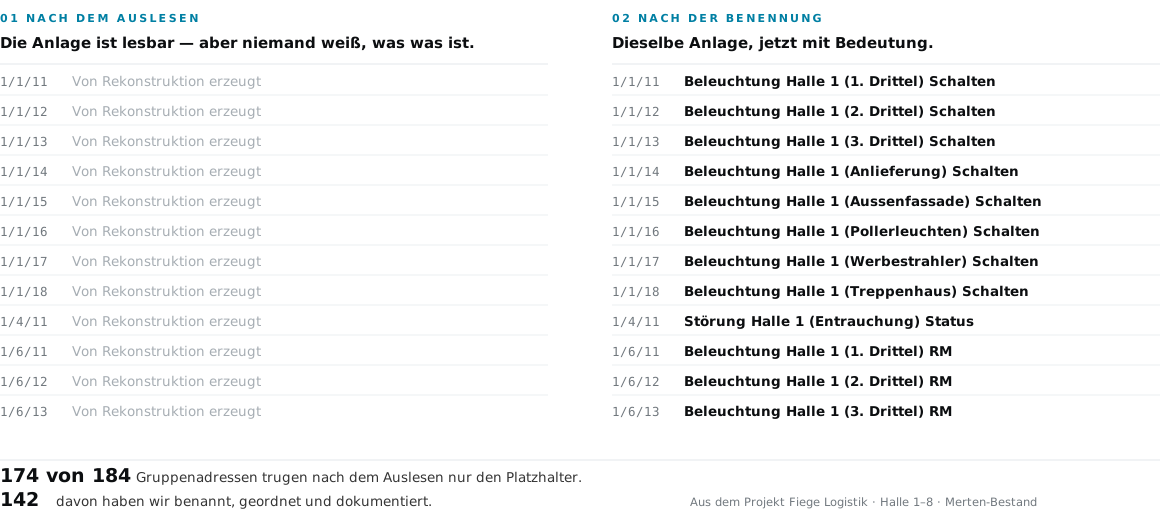
The old names cannot be recovered — they are not stored in the device. We assign them afresh, in consultation with those who know the building.
An order of magnitude, so you can run the numbers.
“A custom quotation” is no help when you are trying to think it through. So here is an anchor — not a fixed price, but an honest ballpark figure.
A detached house of about 150 m², switching and dimming actuators. For that we need roughly a week.
With logic modules it takes longer, with commercial systems considerably longer. Naming is the largest share of the work.
A phone call and an initial indication cost nothing. The figure becomes reliable once we have seen photos of the distribution board or a device list.
You do not need to know what is installed.
Most people who get in touch here have taken over a house and know of the controls only that they exist. That is enough to start with. Four questions, then we talk.
- 01We read your answers and get back to you — usually on the same working day.
- 02Ten minutes on the phone, in which we sort out what exists and what is missing. A photo of the distribution board helps, but is not a requirement.
- 03Then a written assessment with an effort range. Only then do you decide.
Even "in your case this is not worth doing" is a result we will tell you. Both cost you nothing.
Rather talk straight away+49 211 838 66 870Clearly answered.
How does a system readout work in practice?
Remotely at first: via an existing IP gateway, or one we send you, we connect to the bus and read out the device inventory. That already gives a very accurate picture. We then clarify whether a site visit is needed — usually for installation locations, distribution boards and matching control points to rooms.
Does the readout disrupt day-to-day operation?
No. The readout is a read-only operation on the bus; lighting, heating and shading continue as normal. We only make changes once they have been agreed with you — and then in time windows that suit your operations.
Is it worth it for a smaller system too?
If you are planning changes or have just taken over the property: yes. The effort scales with the number of devices, and for small systems in particular the diagnosis is done quickly. If the remote diagnosis shows that the effort is not worth it, we say so.
Will I get the data even if I work with someone else afterwards?
Yes. The documentation and the ETS project belong to you — that is the point of the exercise. We never hold anything back to make ourselves indispensable. A system that any electrical contractor can maintain is worth more than one only we understand.
Everything on KNX reconstruction
Specialist software, gateway programming, BACnet and Modbus, logistics halls, remote diagnosis — the complete overview.
To the KNX reconstruction overview page →KNX reconstruction in Cologne, Düsseldorf & NRW.
smartfabrik is a smart home planning practice based in Düsseldorf (Reisholzer Werftstr. 31A). We plan for private clients and companies in Cologne, Düsseldorf and across North Rhine-Westphalia — and, where wanted, nationwide and internationally. A selection of the places we have already planned and delivered in: